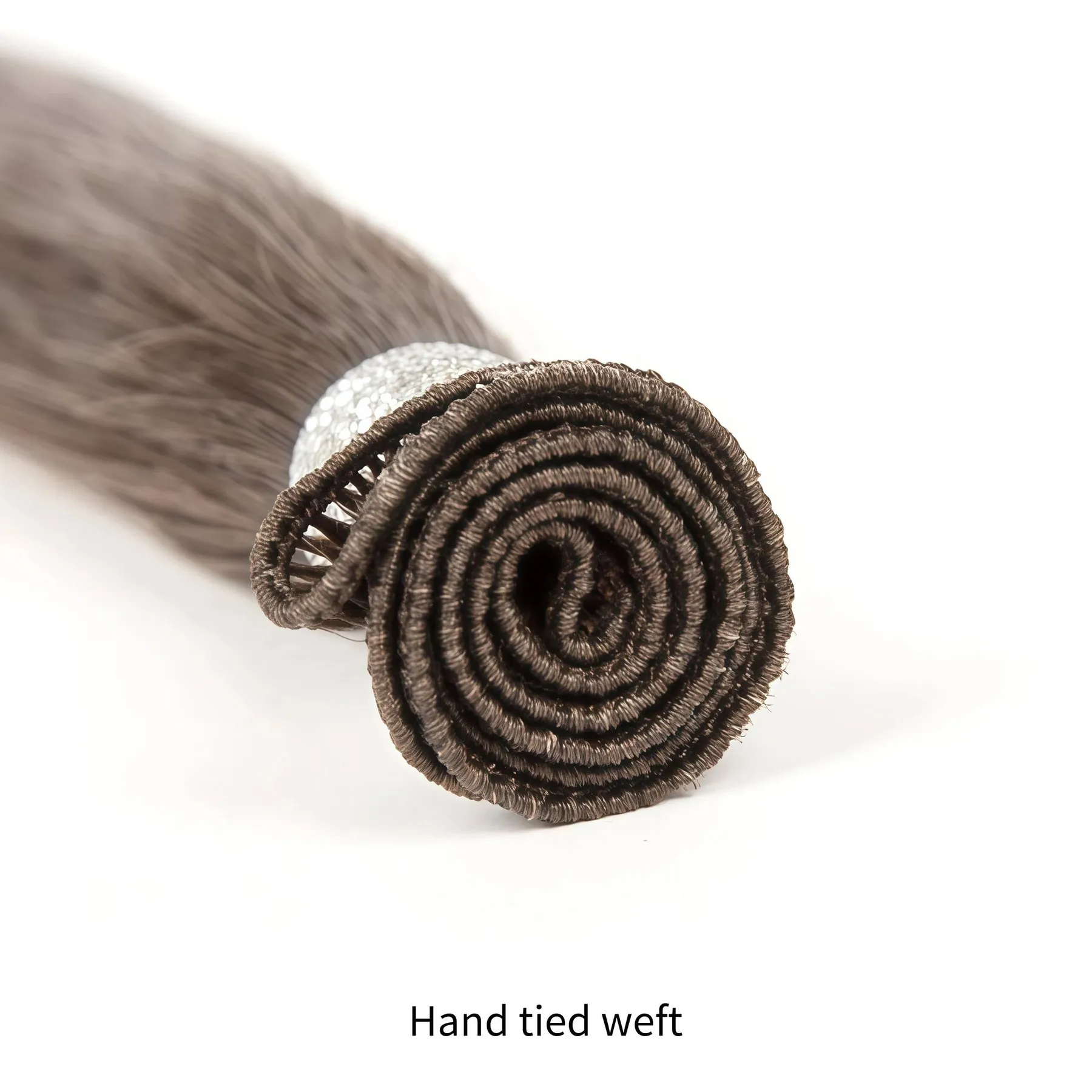
Hand-Tied Weft
Hand-Tied Wefts with a hand-worked seam for professional extension applications. Choose section widths, hair quality, length, colour and pack weight; follow the selected seam’s edge-handling guidance.

HAND-TIED WEFT MANUFACTURING
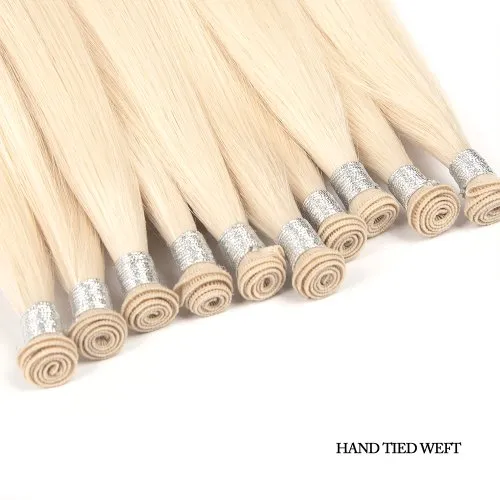
Hand-Tied Weft is a weft construction in which hair is tied onto supporting threads to create a lightweight track.
Unlike many Genius-style continuous wefts, traditional Hand-Tied Weft is generally supplied in fixed sections and should not normally be cut through unless the cut edge is secured according to the manufacturer's method.
PRODUCT SPECIFICATION
| Specification | Development options |
|---|---|
| Construction and supply form | Hand-worked tied track, generally supplied in fixed sections. Agree the section layout and identify each piece before production. |
| Published length references | The current catalogue contains labelled 18-inch, 20-inch and 22-inch Hand-Tied references. These are individual examples, not a confirmed complete size range or stock promise. |
| Section and pack basis | Record width, hair-only weight and identity for each section, then the section count and total pack weight. Different section layouts are not interchangeable at the same pack weight. |
| Cutting restriction | Do not freely cut through the tied track. If shortening is required, use the securing method specified for the approved construction and evaluate the new edge. |
| Private label | Labels, product cards, bags and boxes are developed around the approved product and artwork. |
Develop the length, dimensions and quantity around your product requirements. The approved sample and specification provide the reference for production and repeat orders.
Choose the length, weight, colour, texture and packaging for your collection. The options below are starting points; your approved sample sets the final product configuration.
| Specification | Options and order details |
|---|---|
| Weight basis | g per weft / piece or specified pack |
| Sample weight options | 50 / 100 g per weft / piece or specified pack |
| Length options | 14, 16, 18, 20, 22, 24, 26, 28, 30 inches. Custom lengths can also be developed for the selected product. |
| Colours | Solid / Natural shades; Piano / Mixed / Blended; Rooted / T-Color; Ombre; Balayage; Blonde / Platinum; Custom Shade Matching |
| Texture | Straight / Wavy / Curly; matched to your approved sample. |
| Hair quality | Premium Remy / Cuticle Remy / Fully Cuticle-Intact Remy |
| Construction | Finished weft width and number of pieces per pack; Net hair weight separately from seam/base weight; Construction-specific cutting and edge treatment |
| MOQ | For gram-based extensions and bulk hair, standard starting quantities are 100g per solid colour and 200g per T-Color or mixed colour. The final minimum depends on construction, colouring and order size; sample and trial quantities are quoted separately. |
| Packaging | Custom labels, shade identification, product cards, bags and boxes. |
Compare our hair-quality grades · Specifications, sampling and timing →
Request this specificationA hand-worked seam needs its own width and edge-handling specification. Compare it with Genius only after defining your intended installation and cutting plan.
Hand-Tied Wefts with a hand-worked seam for professional extension applications. Choose section widths, hair quality, length, colour and pack weight; follow the selected seam’s edge-handling guidance.
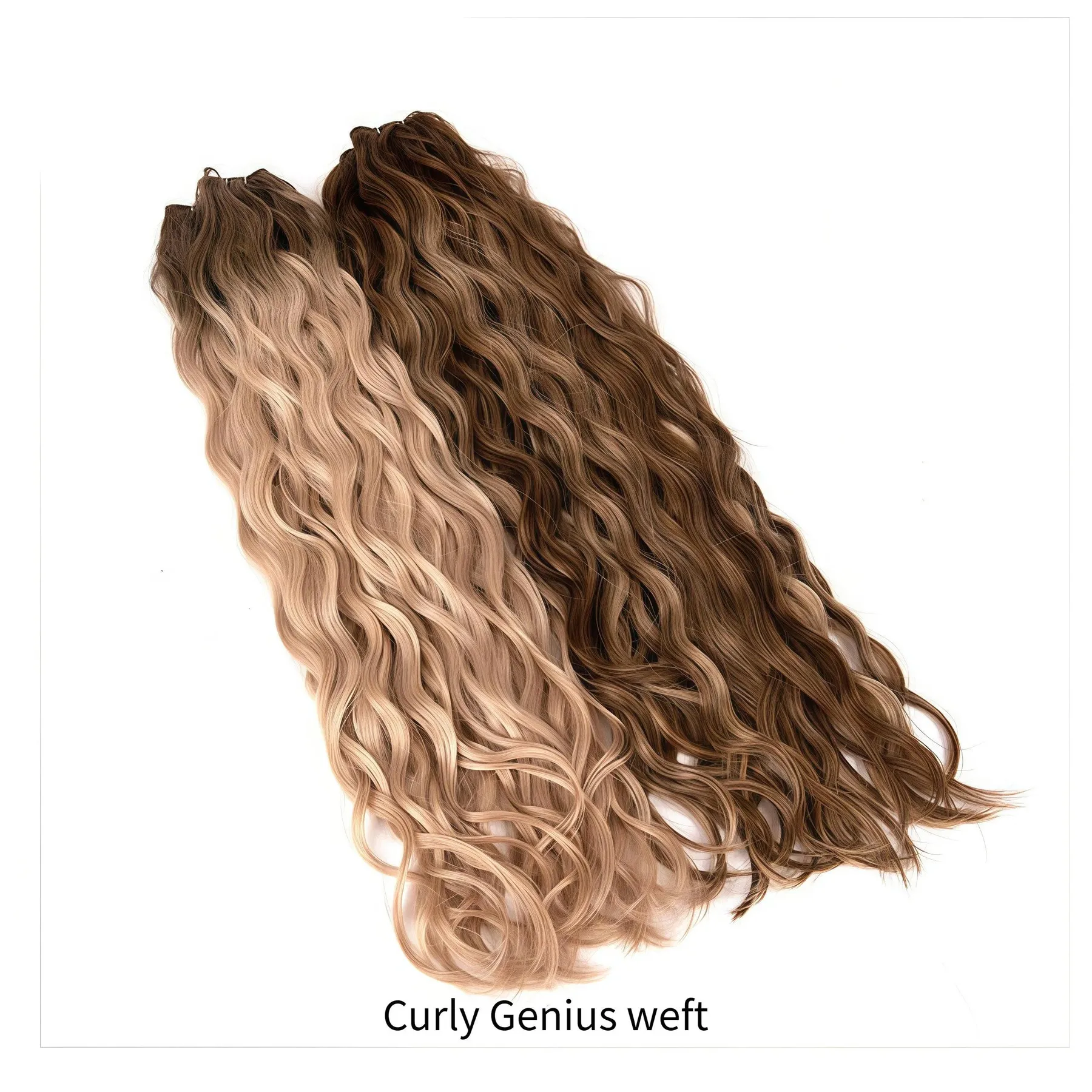
We supply Genius Weft hair extensions, including no-return-hair constructions, for salons and hair-extension brands. Choose your product reference, length, colour and net hair weight, then enquire about samples and wholesale pricing.
Browse all published weft references · Compare Genius and Hand-Tied Wefts
QUICK ANSWER
A high-quality Hand-Tied Weft should combine a low-profile track with consistent tying, stable edges, even hair distribution and controlled weight. Buyers should inspect the seam, return hair, density, width consistency, end fullness and how the track behaves during normal handling. Hair performance must still be tested separately from the tied construction.
CONSTRUCTION & HANDLING
The supporting threads hold the section together. Compare tying consistency, return hair and edge stability across more than one piece. Do not apply a Genius-style free-cutting assumption to a Hand-Tied sample.
Review the product-specific quality checks · Keep a sample evaluation record
STRUCTURAL DISTINCTION
Traditional Hand-Tied Weft relies on a tied thread structure. The finished track is commonly supplied in planned sections, and the tying helps maintain the integrity of each section. Cutting through that structure can allow the edge to loosen if it is not secured correctly.
This is different from a cuttable Genius-style construction designed to be divided at more positions. The distinction affects how a salon plans widths, combines pieces and manages edges during installation. It should be confirmed before a buyer approves packaging, piece counts or a finished set.
For a detailed structural comparison, read Genius Weft versus Hand-Tied Weft.
SUPPLY FORM
The supply form should match the intended installation plan. A buyer needs to know whether the product arrives as fixed pieces or another confirmed format, how many sections are included, and how the width and weight are distributed between them.
Planning only by total pack weight can hide differences between products. Two packs may contain the same net hair weight while using different numbers of sections, different widths or different weight per section. Those differences affect salon workflow and the way density is distributed around the head.
Record the number of sections, width of each section and net hair weight. If sections differ, identify each one rather than recording only a pack total.
Confirm how the stylist expects to position pieces and whether any width adjustment is likely. Do not assume that free cutting is appropriate.
If a section must be shortened, use the securing method specified for the approved product. The method should be tested before it becomes part of salon instructions.
Retain a section layout and approved sample so the next order can be checked against more than colour and total pack weight.
SAMPLE MEASUREMENT
Measure the physical product before washing so the construction record is not mixed with later handling changes. Select more than one section when available and compare measurements across the sample.
| Specification | Development options |
|---|---|
| Supply form | Fixed sections, piece count and identification of each section |
| Weft width | Measured for each relevant section |
| Net hair weight | Recorded by section or by a clearly defined group |
| Usable hair length | Measured independently from the tied track |
| Seam profile | Visible thickness, flexibility and consistency along the track |
| Tying and edges | Consistency, loose areas and stability during normal handling |
| Hair distribution | Density, return hair and evenness through the section |
| End fullness | Lower-length density evaluated against the agreed specification |
| Colour and texture | Compared with the approved physical reference |
After the construction record is complete, wash and style the hair using the documented sample method. Our sample-evaluation guide explains how to keep baseline, wash and attachment observations separate.
SEPARATE APPROVALS
A well-constructed Hand-Tied Weft can still use unsuitable hair, and premium hair can still be assembled into an inconsistent weft. B2B approval should therefore separate hair performance from weft construction.
For the hair, review the documented material definition, usable length, net weight, end fullness, colour and behaviour after washing and styling. For the track, review tying consistency, seam profile, width, edges, return hair and the way the section handles before and after the agreed test.
This separation makes corrective work clearer. If colour shifts but the track remains stable, the issue belongs to the colour or material route. If the hair performs well but an edge loosens, the construction needs attention. See our hair-quality definitions for the material side of approval.
B2B DEVELOPMENT
Define section width, piece count, net hair weight and edge-handling requirements according to the intended installation plan and approved Hand-Tied Weft sample.
MATERIALS & COLOURS
Choose the material, shade and fullness for the intended section layout. Compare colour across the finished pieces and keep the hair wash-and-style record separate from tying and edge observations.
Use a physical colour ring, swatch or extension. Approve the shade and placement on the finished construction; screen photographs communicate direction.
Compare hair-material definitions · Plan physical colour development
SAMPLE & APPROVAL
Send the intended section layout, usable length, colour and installation context. Add the width, hair-only weight and number of sections where known, and flag any expected width adjustment.
Build a Hand-Tied Weft specification →
Sample quantity and lead time are confirmed for the product, material and colour. Confirm when the timing starts and keep production time separate from shipping.
FAQ
A high-quality Hand-Tied Weft combines a low-profile track with consistent tying, stable edges, even hair distribution and controlled weight. Buyers should examine more than the softness and colour of the hair.
Inspect seam profile, return hair, width consistency, density through the section, end fullness and normal handling. Then evaluate the hair after washing because construction and fibre performance are separate.
Normally, no. Traditional Hand-Tied Weft depends on tied thread structure, so cutting through the track can allow the construction to loosen.
If a stylist must shorten a section, the cut edge should be secured using the method specified for that product. The method should be confirmed with the supplier and tested rather than assumed.
No. Hand-Tied Weft describes the construction of the extension track, while hand-tied installation describes a salon application method.
Different weft constructions can be installed using bead-and-thread techniques. Buyers and educators should name the product construction and installation method separately to avoid giving salons incorrect handling instructions.
Neither is universally better. Hand-Tied Weft can suit buyers who prefer fixed weft sections and traditional tied construction, while Genius Weft offers greater cutting flexibility when custom widths are required.
The right choice depends on seam profile, density, weight, cutting requirements, supply form and installation plan. Compare physical samples under the same hair and colour specification where possible.
Measure weft width, net hair weight and usable hair length. Inspect seam profile, tying consistency, hair distribution, return hair, end fullness and edge stability across more than one section.
After recording those construction variables, wash and style the hair. This prevents an attachment observation from being confused with a hair-quality result.
START A PRODUCT CONVERSATION
Send the intended section layout, widths, weight, hair specification, colour and installation context. We can review the sample direction before bulk production.